
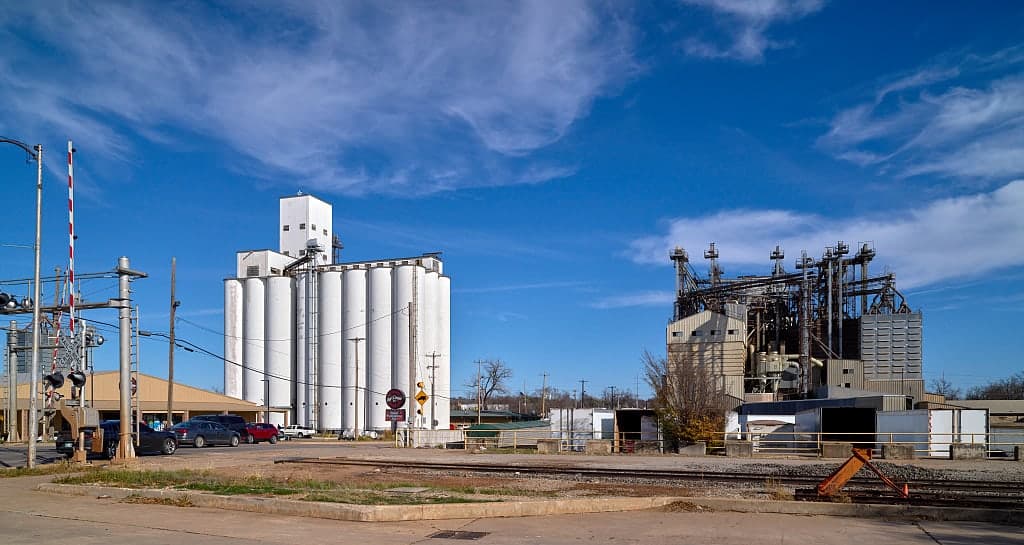
Oklahoma harvested roughly half a wheat crop this year.
Production was put at 48.9 million bushels against 101.1 million in 2025 — 2.043 million harvested acres at an average of 23.93 bushels. The estimate came out of the 2026 Oklahoma Grain and Feed Association meeting, assembled by crop scouts, extension specialists, and grain elevator representatives who walk the fields rather than model them.
The cause is not complicated. "We started with a little bit of moisture," Oklahoma State University's Josh Bushong said, "but for the most part, it was a very dry winter, and then coming into early spring, hot, dry and windy." Heat and drought pushed the state toward a record-early harvest, which was largely finished by mid-July. The picture worsens moving west: the Panhandle was hit repeatedly and southwest Oklahoma took the drought hard.
A short crop is survivable on its own. What makes this year different is what is happening to the herd at the same time.
Pasture recovered somewhat from early spring but stayed weaker than last year, and some ranchers have begun selling cattle early because the grass died and the ponds went dry. Cattle prices are high. That sounds like consolation and mostly is not, because a producer selling into a strong market to escape a feed bill is liquidating an asset he intended to keep. Herd rebuilding takes years and the decision to sell a bred cow is a decision about 2031, not about August.
Sitting on top of all of it is the New World screwworm. The USDA confirmed an infestation in an animal in Texas on June 3. There has been no confirmed Oklahoma case. The federal response has been to push sterile fly releases north through Mexico and into a buffer inside Texas, and State Veterinarian Rod Hall has laid out Oklahoma's plan to the State Board of Agriculture, built around surveillance and producer education rather than any expectation of stopping a fly at a state line.
The exposure worth understanding is commercial, not just veterinary. Several states — California most consequentially, given the size of the trade — restrict livestock imports from states with confirmed infestations. For an industry this large, a single confirmed Oklahoma case would be a market event before it is an animal-health event.
None of this argues for a new program. It argues for the boring things being in order before they are needed: culling decisions made on paper rather than in a panic, water hauled before the pond goes, and a producer who knows what a screwworm case actually looks like on an animal, because the surveillance plan depends on ranchers reporting it early.
Sources: Oklahoma Farm Report: 2026 wheat crop cut in half by drought · Farm Talk: heat and drought push a record-early harvest · KGOU Capitol Insider: screwworms and the state response · USDA APHIS: New World screwworm response