
“My greatest fear is that people don’t understand our system of government.”
Justice Sonia Sotomayor said that in Tulsa this month while talking about what she described as a troubling decline in civics education. She warned that Americans increasingly do not understand basic constitutional structures, the First Amendment, or the assumptions on which our system of government rests.[1]
There may be no branch of government where that lack of understanding is more pronounced than the judiciary.
Most people will never watch a jury trial from beginning to end. They will never sit through a preliminary hearing, hear lawyers argue over whether evidence is admissible, listen to a judge explain the burden of proof, watch a defendant enter a plea, or see the long stretches of ordinary procedure that make up most of the justice system.
Instead, we tend to experience courts in fragments: the mugshot, the charging document, a reporter standing outside the courthouse, the verdict, the sentence.
The actual proceeding in between remains largely invisible.
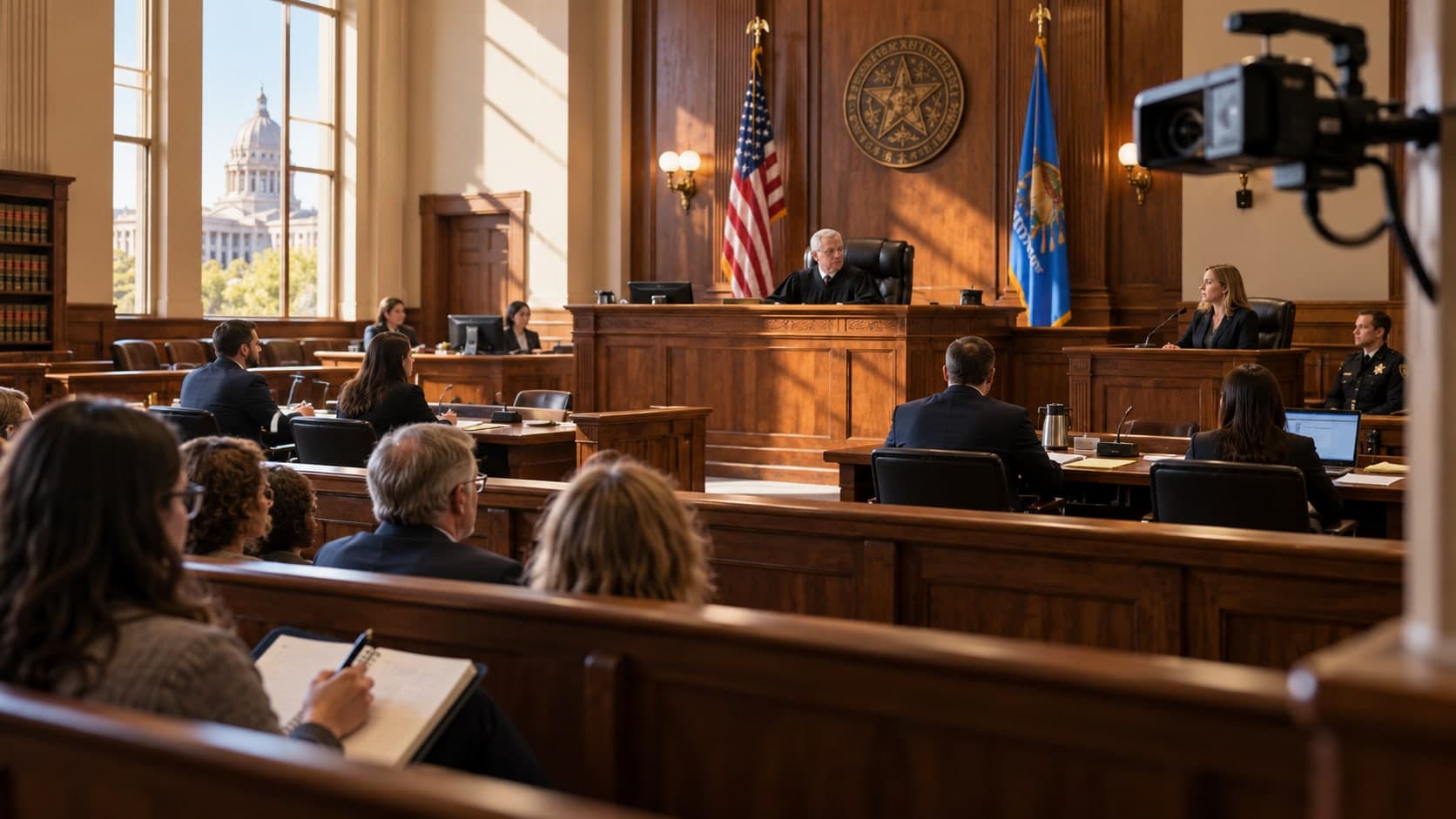
That is especially strange because courtrooms are supposed to be public. In Tulsa County, for example, members of the public may physically attend most open proceedings, but the local court rule begins from the opposite position when technology is involved: cameras and recording equipment are prohibited unless the individual judge expressly permits them.[2]
That produces an odd definition of an “open court.”
That produces an odd definition of an “open court.”
A citizen who can take a Tuesday afternoon off work, drive downtown, find parking, clear courthouse security and locate the right courtroom may watch the government operate.
A citizen in Guymon, Broken Arrow or McAlester generally cannot.
That gap is part of what Senate Bill 1386 attempted to address this year.
The March 24 floor substitute to SB 1386 would have directed the Oklahoma Supreme Court to establish a pilot project using audio and video recording equipment in at least twelve courtrooms, with preference given to courtrooms without a court reporter. The proposal was not simply about creating another piece of courtroom technology. Its text expressly included preservation of public access to judicial records among the purposes of the project.[3]
The proposal also anticipated many of the objections usually raised when courtroom cameras are discussed.
Judges could restrict recording, but the rules would require written findings supported by clear and convincing evidence and narrowly tailored to protect a compelling interest. Family-law recordings would receive restricted, encrypted access. Jurors and prospective jurors could not be photographed or recorded. Neither could certain protected minors, victims, witnesses, vulnerable adults, or people whose identities are confidential under state or federal law.[4] The bill contemplated rules governing access, reproduction and distribution. Official recordings could not be used for harassment, intimidation or knowing misrepresentation of judicial proceedings. The proposal also called for restrictions on commercial exploitation unrelated to legitimate news reporting, academic research, legal education or public-interest commentary.[5]
The recordings would contain metadata sufficient to verify authenticity and detect alteration. They would become part of the record of the proceeding but would not automatically replace a certified transcript. When no court reporter was present, or no transcript had been prepared, the presiding judge could designate the recording as the official record by written order.[6]
SB 1386 did not receive final passage during the 2026 legislative session. The issue, however, did not disappear. Sen. Christi Gillespie and Rep. Derrick Hildebrant requested a legislative interim study titled “Courtroom Transparency,” which has been assigned to the Senate Judiciary Committee.[7]
The timing is appropriate, because Oklahoma has plenty of history demonstrating why transparency in the judicial branch matters.
The most extraordinary example occurred at the highest level of the state judiciary.
Former Oklahoma Supreme Court Justice Nelson S. Corn eventually admitted that, while serving on the court, he had accepted money and agreed to vote as an Oklahoma City attorney directed him. The Oklahoma Supreme Court later described an arrangement in which Corn accepted money over a period of years and, in later cases, took substantial bribes for favorable decisions. In one case the Court ultimately vacated its own prior decision after determining that Corn had accepted a bribe for his vote.[8]
That scandal was not minor institutional embarrassment. It shook confidence in the Oklahoma Supreme Court and helped produce significant reforms to the state judiciary.
That scandal was not minor institutional embarrassment. It shook confidence in the Oklahoma Supreme Court and helped produce significant reforms to the state judiciary.
A courtroom camera would not have discovered a secret bribe negotiated outside the courthouse. Cameras are not a substitute for investigative journalism, whistleblowers, disciplinary authorities or prosecutors.
But Oklahoma’s history contains more recent examples in which simply being able to see what happened proved remarkably important. In 2023, Lincoln County District Judge Traci Soderstrom presided over a murder trial involving the death of a two-year-old child. Courthouse security video showed the judge repeatedly using her phone while testimony was being presented. A subsequent investigation revealed that she had exchanged more than 500 text messages with her bailiff during the trial, including messages commenting on lawyers and witnesses. Facing proceedings seeking her removal, Soderstrom resigned in February 2024 and agreed not to seek judicial office again.[9]
The significance of that episode is not that video independently resolved every allegation against Soderstrom.
It is that the public did not have to rely entirely on competing recollections about whether a judge had been paying attention during a murder trial. There was a recording.
It is that the public did not have to rely entirely on competing recollections about whether a judge had been paying attention during a murder trial. There was a recording.
Oklahoma has seen more bizarre judicial misconduct as well. Former Creek County District Judge Donald Thompson was convicted of four felony counts of indecent exposure for conduct that occurred while he was on the bench presiding over contested hearings and jury trials. Court personnel testified that they saw him expose himself during proceedings. The Oklahoma Supreme Court eventually disbarred him, writing that conduct of that kind could only undermine public confidence in the dignity and integrity of the judiciary.[10]
Again, a camera does not guarantee good behavior. It does something more basic: it creates an objective record of what occurred in a place where enormous government power is exercised.
Other states have spent decades testing whether that access can coexist with fair trials.
Florida is the most useful example.
Florida is the most useful example.
Its experiment with electronic courtroom coverage began in the 1970s. In 1981, the United States Supreme Court considered a constitutional challenge after criminal defendants argued that television coverage had denied them a fair trial. In Chandler v. Florida, the Court rejected the idea that cameras are inherently incompatible with due process. The Constitution, the Court held, did not prevent states from experimenting with televised criminal proceedings where adequate protections existed.[11]
Florida’s current rule generally permits technological coverage of public judicial proceedings, but the presiding judge retains authority to control proceedings, preserve decorum, prevent distraction and protect the fair administration of justice. The rules limit equipment and personnel and protect private conversations between lawyers and clients and conferences at the bench.[12]
In other words, Florida’s model is not “put a television crew wherever it wants to go.”
It is access governed by rules.
It is access governed by rules.
Minnesota provides a more recent example. Its current rules allow judges to authorize audio and visual coverage in criminal trials before a guilty plea or verdict, subject to restrictions designed to protect victims, witnesses and the integrity of the proceeding. Jurors may not be shown. Minors receive categorical protections in many circumstances. Adult victims and witnesses have objection rights. Judges retain authority to limit, suspend or terminate coverage when circumstances require it.[13]
The most famous modern example of that system was the trial of Derek Chauvin for the murder of George Floyd.
Judge Peter Cahill allowed the proceeding to be recorded and broadcast subject to detailed restrictions. Cameras were fixed. Jurors were protected. Sidebars and off-record communications were excluded from audio coverage. Millions of Americans were therefore able to watch not a recreation or a reporter’s summary, but an actual criminal trial.[14]
At least 23 million Americans watched the verdict live on television, according to Nielsen estimates reported at the time.[15]
That level of attention inevitably created argument. People debated police practices, causation, expert testimony, use-of-force standards, burden of proof and the role of jurors. Some of that discussion was informed. Some was not.
But millions of people also saw things that television crime dramas rarely teach accurately.
They saw that lawyers cannot simply say whatever they want in court.
They watched objections sustained and overruled.
They watched objections sustained and overruled.
They saw experts cross-examined.
They watched evidence admitted and excluded.
They heard a judge instruct jurors about the actual legal standards they were required to apply.
That is civic education in a form no textbook can quite replicate.
That is civic education in a form no textbook can quite replicate.
There is empirical support for that proposition, although the research does not justify claiming that cameras automatically improve public trust. The Federal Judicial Center evaluated a four-year pilot involving video recording of civil proceedings in fourteen federal district courts. A majority of judges who expressed an opinion believed recording had a moderate-to-great effect on increasing public access and educating the public about courtroom procedures. Participating lawyers reported similar views about the public-facing benefits.[16]
The public actually used the recordings. During 2014 alone, videos in the pilot were accessed more than 21,000 times. Among surveyed viewers, 44 percent said they were motivated by a general interest in observing federal court proceedings and 40 percent identified an educational purpose. Students, educators, members of the general public and lawyers were among the users.[17]
The study came with an important limitation: participation by judges and lawyers was voluntary, meaning the participants were likely more receptive to cameras than judges and lawyers nationally. The researchers said so explicitly.[18]
More recent experimental evidence is similarly nuanced.
More recent experimental evidence is similarly nuanced.
A 2026 study published in The Journal of Legal Studies randomly assigned real trials in a Chinese court to livestream or no livestream. The researchers found that parties became somewhat more cautious and their statements somewhat less informative when proceedings were broadcast. Judges and lawyers, however, became more stable and less emotional. The researchers found no evidence that broadcasting affected judicial decisions, diverted judges from questioning, or caused lawyers to become more theatrical.[19]
That is a different legal system, so the findings should not simply be transplanted to Oklahoma. But they are useful because they suggest what decades of argument over cameras sometimes obscures: the effects are real, but they are not necessarily the effects either side predicts.
There are legitimate risks.
Trials can become online content.
Trials can become online content.
The Depp-Heard defamation trial demonstrated how quickly courtroom footage can be clipped, memed, monetized and detached from the evidentiary context in which it occurred. A witness can become a social-media character overnight. A few seconds of cross-examination can circulate to millions of people who never watched what came before or after.
Victims may be intimidated by exposure. Witnesses may behave differently when they know their testimony can be replayed forever. Children and sexual-assault victims present obvious privacy concerns. Jurors should not become public personalities merely because they performed a civic duty. Those concerns are not arguments against taking transparency seriously. They are the reason rules matter.
And, notably, the March 24 version of Oklahoma’s own proposal already treated them as problems to be managed. It protected jurors and designated vulnerable people. It restricted family-law recordings. It contemplated limitations on misuse and commercial exploitation. It required judicial findings before access was restricted rather than simply giving every proceeding unrestricted exposure.[20]
That is a more sophisticated debate than “cameras good” versus “cameras bad.”
That is a more sophisticated debate than “cameras good” versus “cameras bad.”
There is also a mistake in assuming that transparency must increase confidence in judges in order to be worthwhile.
Sometimes watching a court proceeding will increase confidence.
Sometimes it may do the opposite.
A citizen might watch a judge patiently protect a defendant’s constitutional rights in an unpopular case and come away understanding why judicial independence matters.
A citizen might watch a judge patiently protect a defendant’s constitutional rights in an unpopular case and come away understanding why judicial independence matters.
Another might watch a hearing and conclude that a lawyer was unprepared, a prosecutor was unfair, or a judge behaved badly.
That is not necessarily a failure of transparency.
Visibility and public relations are different things.
The strongest civic value of courtroom access may therefore be much simpler: citizens have a better chance to base their opinions on the institution they actually observed rather than the institution someone else described to them.
That returns the discussion to Sotomayor’s concern.
Our courts are not side institutions in American government. They decide whether people lose their liberty. They determine custody of children, resolve disputes over property, review government power, interpret constitutions and statutes, and decide whether evidence obtained by police may be used against an accused citizen.
Yet for many Americans, the judiciary is the least understood branch of government.
We hold trials “in public,” but for most people the practical meaning of public access still resembles the nineteenth century: find the courthouse and take a seat. Technology has changed what public access can mean. The central questions for Oklahoma’s courtroom-transparency study are therefore broader than whether a camera might make someone nervous or whether a high-profile trial might become a spectacle. They include what proceedings should be remotely accessible, what protections vulnerable participants require, who controls and preserves the recordings, how misuse should be addressed, and what an “open court” means when physical attendance is no longer the only practical way citizens can observe government.
Cameras cannot guarantee honest judges.
They cannot guarantee informed citizens either.
But they can give citizens something civics education increasingly struggles to provide: the opportunity to watch a constitutional institution operate for themselves.
FOOTNOTES [1] Ginnie Graham, Ignorance of Civics and Government Is the Biggest US Threat, Says Supreme Court Justice Sonia Sotomayor, Tulsa Flyer (Sept. 17, 2026). [2] Okla. 14th Jud. Dist. Ct. R. 11. [3] S.B. 1386, 60th Leg., 2d Reg. Sess., Req. No. 3833, § 1(A) (Okla. 2026) (floor substitute filed Mar. 24, 2026). [4] Id. § 1(B)(3)–(7). [5] Id. § 1(B)(8)–(9). [6] Id. § 1(C). [7] Oklahoma Legislature, Bill Information for S.B. 1386, 60th Leg., 2d Reg. Sess. (2026); Oklahoma Senate, 2026 Interim Studies, IS 2026-36, Courtroom Transparency (2026). [8] Johnson v. Johnson, 1967 OK 16, ¶¶ 3–4, 424 P.2d 414; Marshall v. Amos, 1968 OK 86, ¶¶ 32–34, 442 P.2d 500. [9] Sean Murphy, An Oklahoma Judge Who Sent More Than 500 Texts During a Murder Trial Resigns, Associated Press (Feb. 9, 2024). [10] State ex rel. Okla. Bar Ass’n v. Thompson, 2008 OK 89, ¶¶ 1, 5, 194 P.3d 1281. [11] Chandler v. Florida, 449 U.S. 560, 573–83 (1981). [12] Fla. R. Gen. Prac. & Jud. Admin. 2.450. [13] Minn. Gen. R. Prac. 4.02(d)–(e), 4.04. [14] Order Allowing Audio and Video Coverage of Trial, State v. Chauvin, No. 27-CR-20-12646 (Minn. Dist. Ct. Nov. 4, 2020). [15] Associated Press, Nielsen: At Least 23.2 Million Watched Chauvin Verdict (Apr. 22, 2021). [16] Molly T. Johnson, Carol L. Krafka & Donna J. Stienstra, Federal Judicial Center, Video Recording Courtroom Proceedings in United States District Courts: Report on a Pilot Project 6–8, 28–32 (2016). [17] Id. at 52, 59–61. [18] Id. at 7. [19] John Zhuang Liu & Yingmao Tang, Live Broadcasting the Courtroom: A Field Experiment Using Real Trials, 55 J. Legal Stud. 237, 237–76 (2026). [20] S.B. 1386, 60th Leg., 2d Reg. Sess., Req. No. 3833, § 1(B) (Okla. 2026) (floor substitute filed Mar. 24, 2026).