
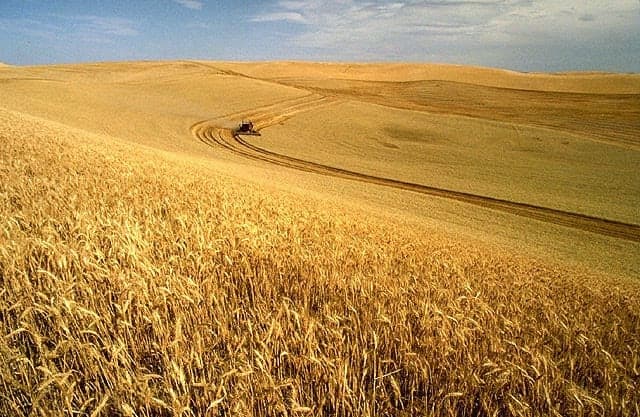
The 2026 Oklahoma wheat harvest is finished, and the size of it is not in dispute. Production came in around 48.9 million bushels. Last year the state made 101.1 million. This crop is roughly half of the two years that preceded it.
The arithmetic behind that number: an average yield near 23.93 bushels per acre across about 2.043 million harvested acres. Both halves of that equation moved the wrong way. Yields fell, and acres that were planted never became acres that were cut.
The cause was drought, and it was not subtle. A very dry winter ran into a hot, dry, windy spring. Stressed wheat is also vulnerable wheat, and western fields carried heavier aphid and mite pressure on top of the moisture deficit — a second bill arriving on top of the first.
Geography decided most outcomes. The picture worsens as you go west. Central and north-central Oklahoma had a good deal of genuinely good wheat. North of Highway 51, early cut ran from the mid-30s into the mid-50s. Southern and central fields averaged something closer to 15 to 25. The Panhandle got hit repeatedly, and southwest Oklahoma was flatly drought-stricken.
There is one thing to bank. Stress concentrates protein, and the Oklahoma Wheat Commission put the statewide average between 12 and 13 percent. In a milling market that pays for protein, a smaller crop that tests high is worth more per bushel than the same tonnage of soft, low-protein grain. It does not replace the missing bushels. It does mean the ones that made it are not a consolation prize.
Harvest ran fast where it ran at all. By late June the state was around 95 percent complete, moving quickly in part because there was simply less to cut, and finishing under heavy rain that arrived too late to help the crop and early enough to complicate the last passes.
The wider consequence lands on the co-ops and the custom cutters. Elevators sized for a hundred-million-bushel year do not become cheaper to run in a fifty-million-bushel one, and a cutting crew that plans a route on expected acres eats the difference when those acres are abandoned. Fixed costs against half the volume is the actual squeeze, and it will still be there next spring regardless of what the rain does.
That is the number to hold onto going into fall planting: not the price, but whether there is subsoil moisture to plant into.
That is the number to hold onto going into fall planting: not the price, but whether there is subsoil moisture to plant into.
Sources: Oklahoma Farm Report: 2026 wheat crop cut in half by drought · Oklahoma Farm Report: harvest nears 95% completion