
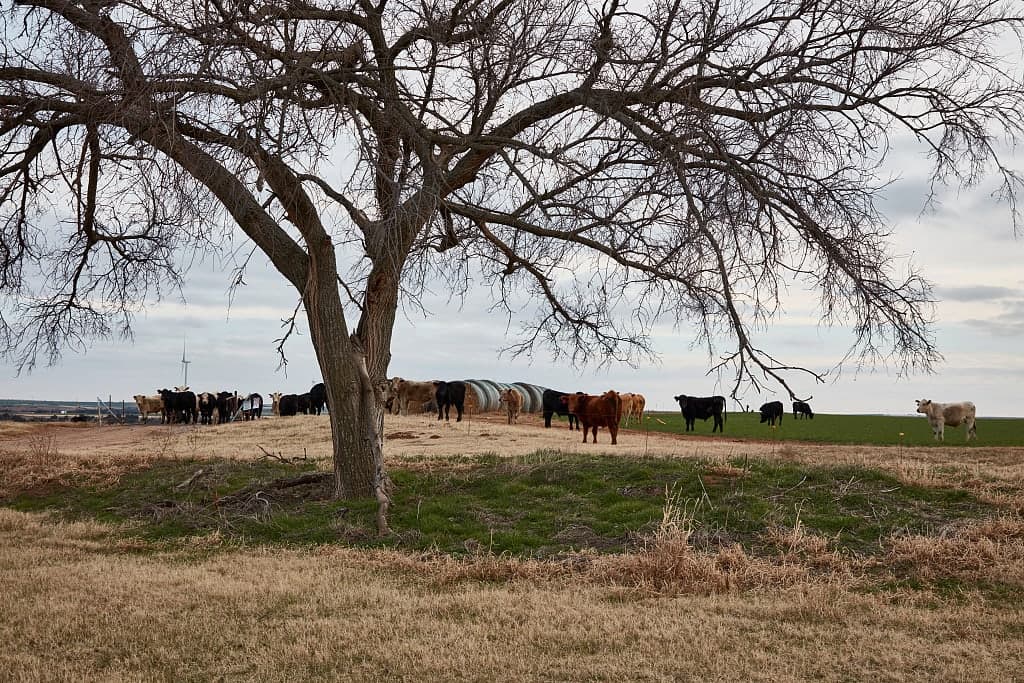
In a drought year the parts of a rural county that keep working are rarely the parts anyone budgets for.
The measurable damage is easy to state. Oklahoma's 2026 wheat crop came in around 48.9 million bushels against 101.1 million the year before, with the worst of it in the west. That is a number with a lot of downstream weight — on the elevator, the equipment dealer, the crew that cuts on contract, and every business in a county seat whose customers just had half a year.
What absorbs that weight is a set of institutions that appear in no appropriations bill. The church that runs the food pantry. The 4-H and FFA chapters that keep teenagers in something structured through a summer when the family operation cannot pay a hired hand. The extension office that fields the call about whether to cull. The co-op board that carries an account a little longer than it should.
None of that is sentiment. It is functional infrastructure, and it is what makes the difference between a county that comes through a bad cycle and one that loses its school.
The particular stress of an agricultural downturn is that it is private. A factory closure is an event with a date and a press conference. A family deciding in September whether to sell breeding stock is a conversation nobody outside the house hears, and the people having it are, by disposition, not inclined to broadcast it. That is precisely why the informal networks matter more here than a program would.
Farm stress is a known and studied phenomenon, and the honest thing to say about it is that the people most exposed are the least likely to ask. Anybody who works in that world — a pastor, an extension agent, a co-op manager, a banker — is worth more in a season like this than any messaging campaign, because they are already in the conversation.
The county fair still runs. The stock show still runs. Those are not distractions from a hard year; in a hard year they are the proof that the community intends to have another one.
We cover this because it is the actual condition of the places we report on, and because the beat has been largely abandoned by outlets that treat a county as a dateline rather than a constituency. If your church, chapter, or district is doing something specific this summer that other counties should copy, our tip line is open.
Sources: Oklahoma Farm Report: 2026 crop cut in half by drought · OSU Extension